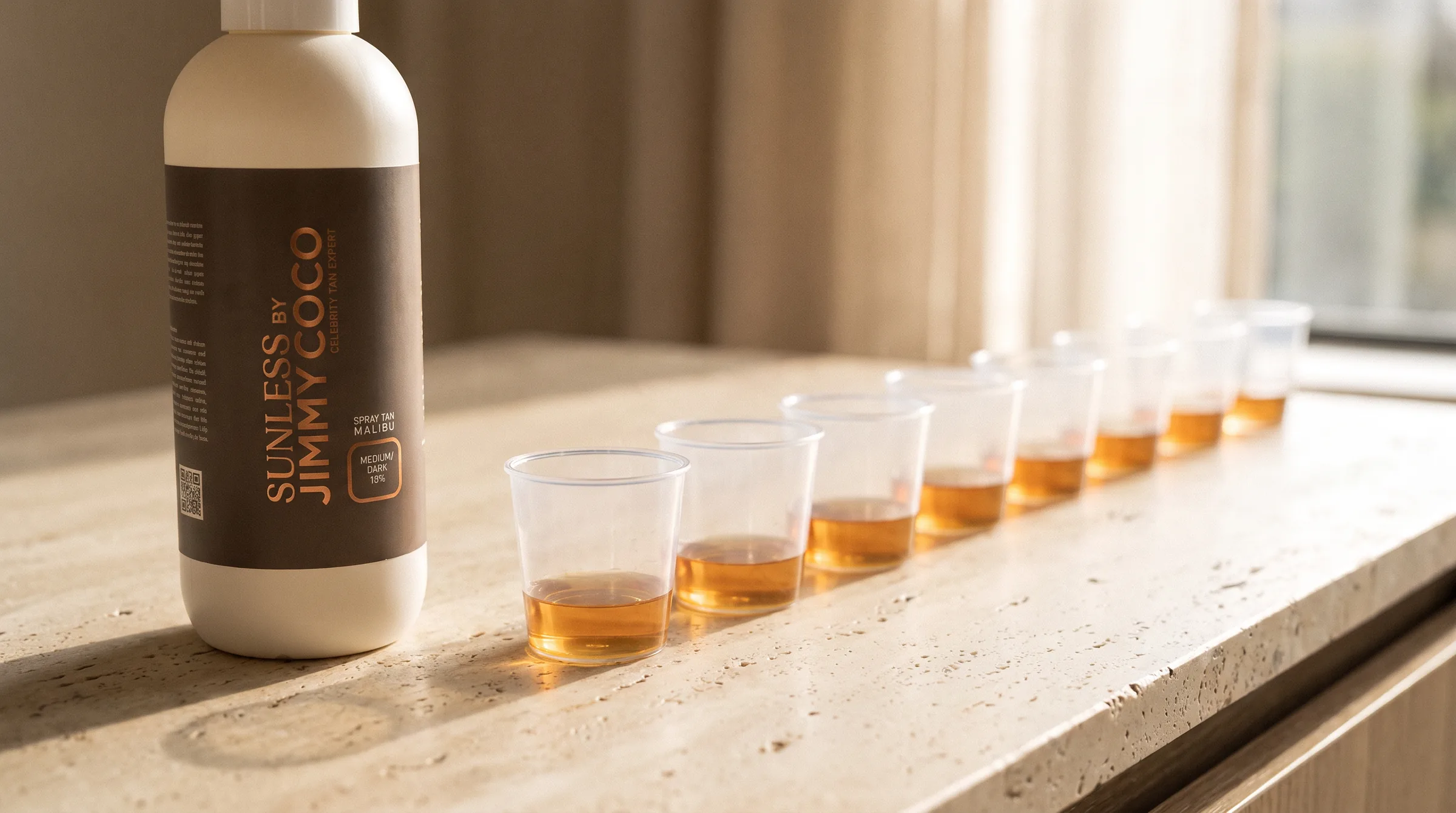
The current one-litre professional solution is rated for approximately 25 to 30 full-body tans. At £60 a litre, that puts the modelled solution cost between £2.00 and £2.40 per treatment.
Using 28 tans as a planning midpoint gives a cost of £2.14 per tan. Your actual result may differ, so it is worth measuring.
If you have ever tried to work out whether the solution on your shelf will last until your next order, the supplier’s estimated yield is a useful starting point.
It is still only an estimate. Your actual yield depends on the treatments you provide, your clients, your equipment and how much solution is lost during normal use.
What the supplier’s estimate means
The current Jimmy Coco professional solution is listed at £60 for one litre and is expected to provide approximately 25 to 30 full-body tans.
Using 28 treatments as a midpoint:
1,000ml ÷ 28 treatments = 35.7ml of bottle stock per treatment
The 35.7ml is the amount used from the bottle for each completed treatment under this model. It is not necessarily the amount deposited on the client’s skin. It can include normal overspray, priming and solution left in the cup or equipment.
At £60 a litre:
£60 ÷ 28 treatments = £2.14 per tan
On a £30 treatment, the modelled solution cost is approximately 7.1% of the price paid by the client.
Use the amount your business actually pays for the litre. Discounts, delivery charges and recoverable VAT can all change the calculation.
Why your result may be different
A manufacturer’s range cannot account for every client, treatment or piece of equipment. Several factors can affect how many tans you produce per litre.
The area being covered. The amount of solution needed will vary with the client’s body size and shape, whether the face is included and whether the service is full-body or partial-body.
The treatment being provided. A treatment using one light application will use less solution than one that includes an intentional second layer.
Your equipment and application technique. Fluid-flow settings, fan pattern, spraying distance, speed and overlap can all affect consumption. Equipment condition and maintenance may also change how evenly the solution is delivered.
Normal working losses. Priming, purging, spills, overspray and solution left in the cup or line all reduce the number of completed treatments produced by a bottle.
A result outside the supplier’s range does not automatically mean the therapist is doing something wrong. It is a reason to check the service mix, application method, equipment settings and any avoidable waste.
A note on additional layers
An additional layer uses more solution and will reduce the number of treatments produced by a litre. That does not mean a second layer should never be used.
The current product instructions recommend applying the first layer sparingly and state that, when a darker result is wanted, a second layer can be applied after five minutes.
Follow the application guidance for the product and equipment you use. Avoid repeatedly spraying wet areas simply because the guide colour looks light, but do not reduce product use at the expense of safe, even coverage and a reliable result.
If some clients receive one layer and others receive two, record that during your yield test. Otherwise, the comparison between treatments will be misleading.
How to measure your actual yield
At twelve tans a week, a litre yielding 28 treatments will last approximately 2.3 weeks. Measure over one full bottle rather than judging it from a few appointments.
- Open a fresh litre and write the date on the bottle.
- Use it for comparable full-body treatments where possible. If it is also used for partial tans, practice or touch-ups, record those separately.
- Mark every completed treatment and note whether it involved one or two layers.
- Record unusual losses such as spills or a larger-than-normal purge.
- Continue until the usable solution is finished and count the treatments completed.
- Repeat the exercise with another bottle and average the results if you want a more reliable figure.
If several therapists use the same product, it may also be useful to measure them separately. Differences can indicate where equipment checks or additional training may be needed.
Do not deliberately change your normal spraying method during the first test. The aim is to measure what currently happens, not what happens when everyone knows they are being watched.
Calculate your solution cost per treatment
Once you know your yield, use:
landed cost of one litre ÷ measured yield = solution cost per tan
For example, if your litre costs £60 and produces 26 full-body tans:
£60 ÷ 26 = £2.31 per tan
If it produces 30:
£60 ÷ 30 = £2.00 per tan
What different yields are worth
The table below uses a £60 litre and 624 completed tans a year:
| Yield per litre | Bottle stock used per tan | Solution cost per tan | Modelled annual solution cost |
|---|---|---|---|
| 25 | 40.0ml | £2.40 | £1,498 |
| 26 | 38.5ml | £2.31 | £1,440 |
| 27 | 37.0ml | £2.22 | £1,387 |
| 28 | 35.7ml | £2.14 | £1,337 |
| 29 | 34.5ml | £2.07 | £1,291 |
| 30 | 33.3ml | £2.00 | £1,248 |
These annual figures show the value of solution consumed. Your cash purchases will be more evenly spread out because litres are bought in whole bottles, and unused stock carries over into the next month or year.
Increasing the yield from 28 to 29 saves approximately £46 a year at this treatment volume, or a little over 7p per tan.
Across the supplier’s full 25-to-30 range, the difference in modelled annual solution cost is approximately £250.
Keep the saving in proportion
Reducing unnecessary waste is worthwhile, particularly when it can be done without affecting the finished result. However, the solution is still a relatively small part of the treatment price.
In the same business model:
- Selling three £18 retail products a week at a 50% margin produces £1,404 in annual gross profit.
- A £2 price increase across 624 tans produces approximately £1,229 after a 1.5% card fee.
- Moving from 25 to 30 tans per litre saves approximately £250 in modelled annual solution cost.
Under those assumptions, the retail and pricing changes are around five times larger than the full yield difference shown here.
That does not mean yield should be ignored. Measure it, investigate obvious waste and make sure the equipment is set up correctly. Once the result is within a sensible range and clients are receiving consistent tans, larger improvements are likely to come from pricing, appointment volume, retention and retail.
Do not choose a solution on price alone. Colour, consistency, application, fade, training and client satisfaction are more important than saving a few pence per treatment.
How to order using your measured yield
Once you know your actual yield, you can estimate average monthly usage:
litres per month = (weekly tans × 52 ÷ 12) ÷ measured yield
At twelve completed tans a week and a yield of 28:
(12 × 52 ÷ 12) ÷ 28 = 1.9 litres a month
That is approximately 22.3 litres of solution used each year. Starting with no stock, you would need 23 whole bottles, with some solution carrying into the following year.
At twenty tans a week and the same yield, average use increases to approximately 3.1 litres a month.
If you stock several formulas, calculate each one separately. A combined average can hide the fact that one solution sells quickly while another remains on the shelf.
Set a sensible reorder point
Your reorder point should take account of:
- Average weekly use
- Supplier delivery time
- Seasonal peaks and confirmed group bookings
- Current unopened and opened stock
- Storage guidance and product shelf life
A spare litre may be sensible during a busy period, but it is not the right buffer for every salon. At twelve tans a week, one litre represents more than two weeks of normal stock under this model.
Date bottles when they are opened and store the solution according to the manufacturer’s instructions. The current Jimmy Coco guidance recommends keeping it in a cool, dark environment and allowing it to reach room temperature before use.
The worked figures use a £60 landed cost, 624 completed full-body treatments a year and a midpoint yield of 28. They assume a non-VAT-registered business. If you are VAT-registered, use your cost after recoverable input VAT and compare it with revenue excluding output VAT. Product prices and application guidance can change, so check the current supplier instructions and substitute your own figures.